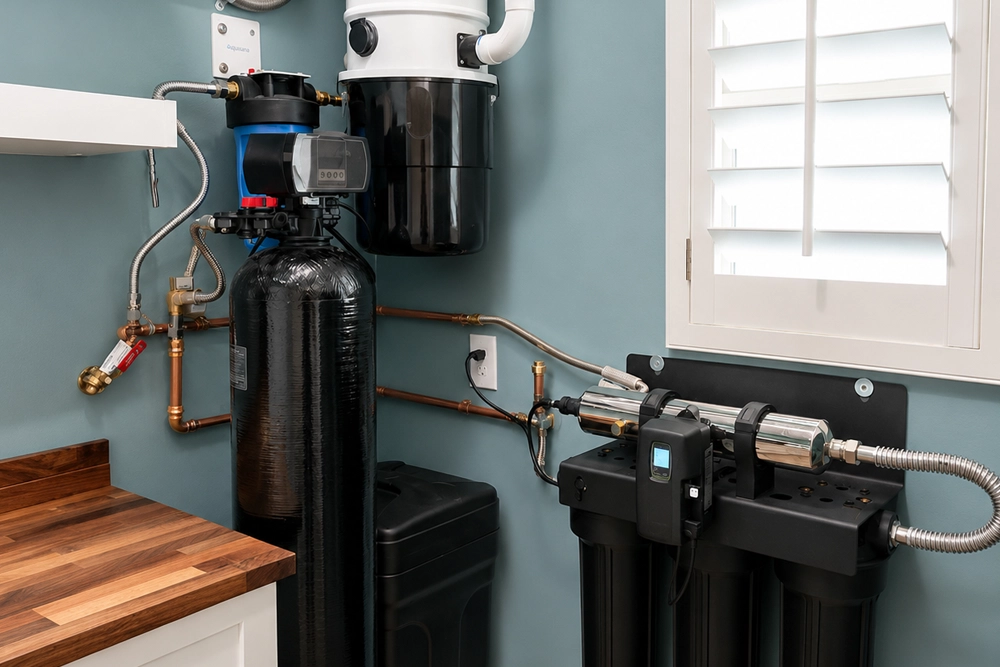
Learn how a whole home water filtration system works, what happens as water moves through the system, and how filtration can improve water throughout your home.
Every time you turn on a faucet, start the dishwasher, take a shower, or fill a glass, the water in your home has already traveled through the same plumbing system. A whole-home filtration system changes what happens before that water reaches you.
If you are wondering how does a whole home water filtration system work, the answer starts at the main water line. Instead of filtering water at just one faucet, the system treats incoming water before it is distributed throughout the house.
Depending on the system, water may pass through several filtration stages designed to reduce sediment, unwanted tastes, odors, and other water-quality concerns. The result is filtered water available throughout the home rather than at only one point of use.
In this guide, we’ll explain where a whole-home filtration system is installed, what happens as water moves through it, the role of different filtration stages, and how to determine whether this type of system makes sense for your home.
Where Is a Whole Home Water Filtration System Installed?
A whole home filtration system is generally installed where the main water supply enters the house.
This placement allows the system to treat water before it is distributed to areas such as:
- Kitchen faucets
- Bathroom sinks
- Showers and bathtubs
- Washing machines
- Dishwashers
- Other plumbing fixtures
This is one of the main differences between a whole-home system and a point-of-use filter.
A faucet-mounted or under-sink filter treats water at one specific location. A whole home water filter is designed to address water before it travels throughout the home's plumbing system.
If you are considering filtration for your Mesa home, you can explore our whole-home water filtration systems to learn more about the service we provide.
What Happens When Water Enters the Filtration System?
The exact configuration varies by system, but water typically moves through a series of filtration stages.
Each stage has a particular job.
1. Water Enters Through the Main Supply Line
Water first enters the property through the main water line.
Before a whole-home filtration system is installed, this water would normally continue directly into the home's plumbing.
With a filtration system in place, the incoming water is routed through the filtration equipment first.
2. Sediment May Be Filtered Out
Many filtration systems begin with a sediment filtration stage.
Sediment filters are designed to capture larger particles that may be present in the water, such as:
- Sand
- Dirt
- Rust particles
- Other suspended debris
Removing larger particles early in the process can also help protect later filtration stages from unnecessary buildup.
Not every whole-home system uses the same type of sediment filter, so the appropriate setup depends on the home's water supply and filtration goals.
3. Water Passes Through the Main Filtration Media
After larger particles are addressed, water may pass through additional filtration media designed to reduce other substances.
One common example is activated carbon filtration.
Carbon filters are commonly used to help reduce certain tastes, odors, and substances that affect how household water smells or tastes.
The type and amount of filtration media should be selected based on what is actually present in the water and what the homeowner wants to improve.
This is why choosing a filtration system should begin with understanding the home's water rather than simply selecting a system based on size or appearance.
What Does a Whole Home Water Filter Remove?
There is no single answer because different filtration systems are designed for different purposes.
Depending on the filtration media and system configuration, a whole-home filtration system may be designed to address concerns such as:
- Sediment
- Unwanted tastes
- Unpleasant odors
- Chlorine or other treatment-related compounds
- Certain minerals or other substances
A whole-home water filtration system should not automatically be assumed to remove every possible contaminant.
The system's capabilities depend on the specific filtration technology being used.
Homeowners should understand what they want to reduce in their water before choosing a filtration solution.
Does Filtered Water Go to Every Faucet?
With a properly configured whole-home filtration system, treated water is distributed through the home's plumbing after it passes through the filtration equipment.
That means filtration is not limited to the kitchen sink.
Depending on the plumbing configuration, filtered water may be available for:
- Drinking
- Cooking
- Showering
- Bathing
- Laundry
- Dishwashing
- General household cleaning
This whole-house approach is one of the main reasons homeowners consider a residential water filtration system instead of relying only on individual faucet filters.
Is a Whole Home Water Filter the Same as Reverse Osmosis?
Not necessarily.
Whole-home filtration and reverse osmosis are different water-treatment approaches.
A whole-home filtration system treats water entering the house and can use different types of filtration media depending on the intended purpose.
Reverse osmosis uses a membrane-based filtration process and is often used when more targeted drinking-water treatment is desired.
Some homeowners may use more than one type of water-treatment system, but the right combination depends on the water-quality goals of the household.
Is a Water Softener the Same as a Water Filtration System?
No. Water softening and water filtration address different water concerns.
A water softener is primarily designed to address hardness minerals that can contribute to scale buildup.
A water filtration system is designed to reduce specific particles, substances, tastes, odors, or other water-quality concerns depending on the filtration technology.
Some homes may benefit from filtration, softening, or a combination of water-treatment approaches.
The appropriate solution depends on the characteristics of the water and what the homeowner wants to improve.
Why Does the Type of Filter Matter?
A filtration system is only useful if the filtration technology matches the water-quality concern.
For example, a sediment filter and a carbon filter perform different functions.
This is why it is helpful to think about questions such as:
- What do you notice about your water?
- Does it have an unpleasant taste or odor?
- Is sediment visible?
- Are you concerned about what is entering the home through the water supply?
- Do you want filtration throughout the house or only at a drinking-water faucet?
The answers help determine what type of water treatment makes sense for the property.
Simply installing more filtration stages does not necessarily make a system better. The goal is to use the right type of treatment for the water and household.
What Happens After the Water Is Filtered?
Once water moves through the filtration stages, it continues into the home's plumbing system.
From there, the treated water is available wherever the plumbing distributes it.
The filtration process happens before you turn on a faucet, start the washing machine, run the dishwasher, or use the shower.
This means homeowners do not need to manually activate the filter every time they use water.
The water passes through the filtration system as part of the home's normal plumbing flow.
Do Whole Home Water Filters Need Maintenance?
Yes.
Filters and filtration media do not last indefinitely.
Over time, captured sediment and other substances accumulate inside the filtration system. Certain filter cartridges or media eventually need to be replaced or serviced so the system can continue operating as intended.
Maintenance requirements vary based on factors such as:
- The type of filtration system
- The filtration media
- Household water usage
- Incoming water quality
- The amount of sediment or other material being filtered
Rather than following a universal replacement schedule, homeowners should follow the maintenance requirements for their specific filtration system.
How Do You Know Which Whole Home Filtration System You Need?
Choosing a system starts with understanding what you want to improve about your water.
A homeowner concerned primarily about sediment may need a different setup than someone focused on taste or odor.
Before selecting a system, consider:
- The quality of your incoming water
- The specific water concerns you want to address
- How much water your household typically uses
- Whether you want filtration throughout the home
- What type of maintenance the system requires
A water filtration professional can help evaluate these factors and determine which treatment approach makes sense. For a side-by-side look at the main options, see our guide to the best water filtration system for home use.
For homeowners in Mesa, our whole-home water filtration service is designed to help address household water-quality needs with a system appropriate for the property.
Whole Home Water Filtration in Mesa, Arizona
Water quality concerns can vary from one household to another, even within the same community.
That is why we do not recommend thinking about whole-home filtration as a one-size-fits-all product.
At Hydrology Water Store, we are a veteran-owned, family-run water store and filtration company serving Mesa, Arizona. Our goal is to make better household water easier to understand.
If you are considering filtration, the first step is understanding what you want the system to accomplish and choosing filtration that matches those needs.
Is a Whole Home Water Filtration System Right for Your Home?
A whole-home filtration system can make sense if you want water treated before it reaches fixtures throughout your house rather than filtering only one drinking-water source.
The system works by routing incoming water through filtration equipment installed on the main supply line. Depending on the system, the water may move through sediment filtration, carbon filtration, or other treatment stages before being distributed through the home.
If you are considering a whole-home water filtration system in Mesa, our team can help you understand your options.
Call (602) 560-4107 to speak with Hydrology Water Store about your household water filtration needs.
Frequently Asked Questions
How does a whole home water filtration system work?
A whole-home filtration system is installed on the main water supply and filters incoming water before it is distributed through the home's plumbing. The exact filtration stages depend on the system and the water-quality concerns being addressed.
Does a whole house water filter filter every faucet?
A whole-home system is designed to treat water before it travels throughout the home's plumbing, so filtered water can reach multiple faucets and fixtures rather than only one drinking-water location.
What does a whole home water filter remove?
That depends on the filtration technology. Different filters are designed to reduce different particles, tastes, odors, substances, or other water-quality concerns. No single filtration system should be assumed to remove everything.
Is whole home filtration the same as reverse osmosis?
No. Whole-home filtration describes systems that treat water entering the house. Reverse osmosis is a specific membrane-based filtration technology and may be used separately depending on the household's water-treatment goals.
Is a whole home water filter the same as a water softener?
No. Water filtration and water softening serve different purposes. A filtration system targets specific water-quality concerns, while a water softener primarily addresses hardness minerals.
Do whole home water filtration systems require maintenance?
Yes. Filter cartridges or filtration media eventually need service or replacement. The maintenance schedule depends on the system, water quality, household usage, and filtration media.